Feilong (simplified Chinese: 飞龙; traditional Chinese: 飛龍; pinyin: fēilóng; Wade–Giles: fei lung; lit. "flying dragon") is a winged legendary creature that flies among clouds in Chinese mythology. The proper name Feilong applies to people, fictional characters, places, martial art techniques, military weapons, and a pterosaur.
Source: http://en.wikipedia.org/wiki/Feilong_(mythology)
Showing posts with label F. Show all posts
Showing posts with label F. Show all posts
Friday, 9 August 2013

Faun
The faun (Latin: faunus, Ancient Greek: φαῦνος, phaunos, pronounced [pʰaynos]) is a rustic forest god or goddess (genii) of Roman mythology often associated with enchanted woods and the Greek god Pan and his satyrs.
Source: http://en.wikipedia.org/wiki/Faun

Source: http://en.wikipedia.org/wiki/Faun

Fairy
A fairy (also fay, fae; from faery, faerie, "realm of the fays") is a type of mythical being or legendary creature in European folklore, a form of spirit, often described as metaphysical, supernatural or preternatural. Fairies resemble various beings of other mythologies, though even folklore that uses the termfairy offers many definitions. Sometimes the term describes any magical creature, including goblins or gnomes: at other times, the term only describes a specific type of more ethereal creature or sprite. Various folkloristic traditions refer to them euphemistically, by names such as wee folk, good folk,people of peace, fair folk (Welsh tylwyth teg), etc.
Much of the folklore about fairies revolves around protection from their malice. Although in modern culture they are often depicted as young, sometimes winged, humanoids of small stature, they originally were depicted quite differently: tall, radiant, angelic beings or short, wizened trollsbeing two of the commonly mentioned forms. One common theme found among the Celtic nations describes a race of diminutive people who had been driven into hiding by invading humans. When considered as beings that a person might actually encounter, fairies were noted for their mischief and malice.
Fairies are generally described as human in appearance and having magical powers. Their origins are less clear in the folklore, being variously dead, or some form of demon, or a species completely independent of humans or angels.
The concept of "fairy" in the narrow sense is unique to English folklore, conflating Germanic elves with influences from Celtic and Romance (French) folklores, and later made "diminutive" according to the tastes of Victorian era "fairy tales" for children. The English term "fairy" can be applied to comparable beings in any of these cultures, more generally to similar beliefs in other European folklores ("Slavic fairies"), or in comparative studies even worldwide. Fairies have their historical origin in the conflation of Celtic (Breton, Welsh) traditions in the Middle French medieval romances, e.g. as one of the beings that a knight errant might encounter. Fairie was in origin used adjectivally, meaning "enchanted" (as in fairie knight, fairie queene), but was used as a name for "enchanted" creatures from as early as the Late Middle English period. Fairies as the term is now understood were shaped in the literature of Romanticism during the Victorian era. Writers such as Sir Walter Scott and James Hogg were inspired by folklore which featured fairies, such as the Border ballads.
Folklorists have suggested that their origin may lie partially in a conquered race living in hiding, or in religious beliefs that lost currency with the advent of Christianity.

Thursday, 8 August 2013
The Myth of Ponce de León and the Fountain of Youth
On
April 2, 1513, Spanish explorer Juan Ponce de León and his crew
became the first recorded Europeans to set eyes on Florida. Legend
holds that they made this discovery while searching for the Fountain
of Youth, a magical water source supposedly capable of reversing the
aging process and curing sickness. A closer look, however, reveals
that the fountain likely provided little to no motivation for their
voyage. In fact, no surviving documents from the time, including
letters from Ponce de León himself, ever mention such a fountain.
Only later did Spanish and U.S. writers connect the two, thereby
turning Ponce de León into a poster boy for gullibility.Tales
of sacred, restorative waters existed well before the birth of
Spanish conquistador Juan Ponce de León around 1474. Alexander the
Great, for example, was said to have come across a healing “river
of paradise” in the fourth century B.C., and
similar legends cropped
up in such disparate locations as the Canary Islands, Japan,
Polynesia and England. During the Middle Ages, some Europeans even
believed in the mythical king Prester John, whose kingdom allegedly
contained a fountain of youth and a river of gold. Spanish
sources asserted that the Taino Indians of the Caribbean also spoke
of a magic fountain and rejuvenating river that existed somewhere
north of Cuba. These rumors conceivably reached the ears of Ponce de
León, who is thought to have accompanied Christopher Columbus on his
second voyage to the New World in 1493. After helping to brutally
crush a Taino rebellion on Hispaniola in 1504, Ponce de León was
granted a provincial governorship and hundreds of acres of land,
where he used forced Indian labor to raise crops and livestock. In
1508 he received royal permission to colonize San Juan Bautista (now
Puerto Rico). He became the island’s first governor a year later,
but was soon pushed out in a power struggle with Christopher
Columbus’ son Diego.Having
remained in the good graces of King Ferdinand, Ponce de León
received a contract in 1512 to explore and settle an island called
Bimini. Nowhere in either this contract or a follow-up contract was
the Fountain of Youth mentioned. By contrast, specific instructions
were given for subjugating the Indians and divvying up
any gold found.
Although he may have claimed to know certain “secrets,” Ponce de
León likewise never brought up the fountain in his known
correspondence with Ferdinand. “What Ponce is really looking for is
islands that will become part of what he hopes will be a profitable
new governorship,” said J. Michael Francis, a history professor at
the University of South Florida St. Petersburg. “From everything I
can gather, he was not at all interested or believed that he would
find some kind of miraculous spring or lake or body of water.” At
least one historian suggests that perhaps Ferdinand, who had recently
married a woman 35 years his junior, told Ponce de León to keep his
eye out for it. But other experts dispute this.
Either
way, Ponce de León set sail in March 1513 with three ships.
According to early historians, he anchored off the eastern coast of
Florida on April 2 and came ashore a day later, choosing the name “La
Florida” in part because it was the Easter season (Pascua Florida
in Spanish). Ponce de León then journeyed down through the Florida
Keys and up the western coast, where he skirmished with Indians,
before beginning a roundabout journey back to Puerto Rico. Along the
way he purportedly discovered the Gulf Stream, which proved to be the
fastest route for sailing back to Europe.Eight
years later, Ponce de León returned to Florida’s southwestern
coast in an attempt to establish a colony, but he was mortally
wounded by an Indian arrow. Just before leaving, he sent letters to
his new king, Charles V, and to the future Pope Adrian VI. Once
again, the explorer made no mention of the Fountain of Youth,
focusing instead on his desire to settle the land, spread
Christianity and discover whether Florida was an island or peninsula.
No log of either voyage has survived, and no archaeological footprint
has ever been uncovered.

Thursday, 1 August 2013
Faunus
In ancient Roman religion and myth, Faunus was the horned god of the forest, plains and fields; when he made cattle fertile he was called Inuus. He came to be equated in literature with the Greek god Pan.
Faunus was one of the oldest Roman deities, known as the di indigetes. According to the epic poet Virgil, he was a legendary king of the Latins who came with his people from Arcadia. His shade was consulted as a god of prophecy under the name of Fatuus, with oracles in the sacred grove of Tibur, around the well Albunea, and on the Aventine Hill in ancient Rome itself.

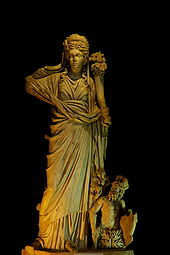
Feronia
In ancient Roman religion, Feronia was a goddess associated with wildlife, fertility, health and abundance. She was especially honored amongplebeians and freedmen. Her festival, the Feroniae, was November 13, Ides of November, during the Ludi Plebeii ("Plebeian Games"), in conjunction with Fortuna Primigenia; both were goddesses of Praeneste.
Source: https://en.wikipedia.org/wiki/Feronia_(mythology)

Source: https://en.wikipedia.org/wiki/Feronia_(mythology)
Flora
In Roman mythology, Flora (Latin: Flōra) was a goddess of flowers and the season of spring. While she was otherwise a relatively minor figure in Roman mythology, being one among several fertility goddesses, her association with the spring gave her particular importance at the coming of springtime. Her festival, the Floralia, was held between April 28 and May 3 and symbolized the renewal of the cycle of life, drinking, and flowers. The festival was first instituted in 240 B.C.E but on the advice of the Sibylline books she was given another temple in 238 B.C.E. Her Greek equivalent was Chloris, who was a nymph and not a goddess at all. Flora was married to Favonius, the wind god, and her companion was Hercules.
On May 23 another festival was held in her honor.

Fontus
In ancient Roman religion, Fontus or Fons (plural Fontes, "Font" or "Source") was a god of wells and springs. A religious festival called the Fontinaliawas held on October 13 in his honor. Throughout the city, fountains and wellheads were adorned with garlands.
Fons was the son of Juturna and Janus. Numa Pompilius, second king of Rome, was supposed to have been buried near the altar of Fons (araFontis) on the Janiculum. William Warde Fowler observed that between 259 and 241 BC, cults were founded for Juturna, Fons, and the Tempestates, all having to do with sources of water. As a god of pure water, Fons can be placed in opposition to Liber as a god of wine identified with Bacchus.
An inscription includes Fons among a series of deities who received expiatory sacrifices by the Arval Brothers in 224 AD, when several trees in thesacred grove of Dea Dia, their chief deity, had been struck by lightning and burnt. Fons received two wethers. Fons was not among the deities depicted on coinage of the Roman Republic.
In the cosmological schema of Martianus Capella, Fons is located in the second of 16 celestial regions, with Jupiter, Quirinus, Mars, the Military Lar,Juno, Lympha, and the Novensiles.
Fortuna
Fortuna (Latin: Fortūna, equivalent to the Greek goddess Tyche) was the goddess of fortune and personification of luck in Roman religion. She might bring good luck or bad: she could be represented as veiled and blind, as in modern depictions of Justice, and came to represent life's capriciousness. She was also a goddess of fate: as Atrox Fortuna, she claimed the young lives of the princeps Augustus' grandsons Gaius and Lucius, prospective heirs to the Empire.
Her father was said to be Jupiter and like him, she could also be bountiful (Copia). As Annonaria she protected grain supplies. June 11 was sacred to her: on June 24 she was given cult at the festival of Fors Fortuna.
Subscribe to:
Posts (Atom)