Showing posts with label folklore. Show all posts

Friday, 9 August 2013

Kitsune

Kitsune (?IPA: [kitsɯne]) is the Japanese word for fox. Foxes are a common subject of Japanese folklore; in English, kitsune refers to them in this context. Stories depict them as intelligent beings and as possessing magical abilities that increase with their age and wisdom. Foremost among these is the ability to assume human form. While some folktales speak of kitsune employing this ability to trick others—as foxes in folklore often do—other stories portray them as faithful guardians, friends, lovers, and wives.
Foxes and human beings lived close together in ancient Japan; this companionship gave rise to legends about the creatures. Kitsune have become closely associated with Inari, a Shinto kami or spirit, and serve as its messengers. This role has reinforced the fox's supernatural significance. The more tails a kitsune has—they may have as many as nine—the older, wiser, and more powerful it is. Because of their potential power and influence, some people make offerings to them as to a deity.


Kappa

Kappa (河童?, "river-child"), alternatively called Kawatarō (川太郎?, "river-boy"), Komahiki (“horse puller”), or Kawako (川子?, "river-child"), are ayōkai found in Japanese folklore, and also a cryptid. Their name comes from a mixture of the word "kawa" (river) and "wappo," an inflection of "waraba" (child). In Shintō they are considered to be one of many suijin (水神,“water deity”), their yorishiro, or one of their temporary appearances. A hair-covered variation of a Kappa is called a Hyōsube (ひょうすべ?). There are more than eighty other names associated with the kappa in different regions which include Kawappa, Gawappa, Kōgo, Mizushi, Mizuchi, Enkō, Kawaso, Suitengu, and Dangame. Along with the oni and thetengu, they are one of the most well-known yōkai in Japan.
Kappa are similar to Finnish Näkki, Scandinavian/Germanic Näck/Neck, Slavian Vodník and Scottish Kelpie in that all have been used to scare children of dangers lurking in waters.
It has been suggested that the kappa legends are based on the Japanese giant salamander or "hanzaki", an aggressive salamander which grabs its prey with its powerful jaws.


Kraken

Kraken (/ˈkrkən/ or /ˈkrɑːkən/) are legendary sea monsters of giant proportions said to dwell off the coasts of Norway and Greenland. The legend may have originated from sightings of giant squid that are estimated to grow to 13–15 m (40–50 ft) in length, including the tentacles. The sheer size and fearsome appearance attributed to the kraken have made it a common ocean-dwelling monster in various fictional works.

Source: http://en.wikipedia.org/wiki/Kraken


Succubus

In folklore traced back to medieval legend, a succubus is a female demon or supernatural entity that appears in dreams, who takes the form of a human woman in order to seduce men, usually through sexual intercourse. The male counterpart is the incubus. Religious traditions hold that repeated intercourse with a succubus may result in the deterioration of health or even death.
In modern fictional representations, a succubus may or may not appear in dreams and is often depicted as a highly attractive seductress orenchantress; whereas, in the past, succubi were generally depicted as frightening and demonic.


Incubus

An incubus (nominal form constructed from the Latin verb, incubo, incubare, or "to lie upon") is a demon in male form who, according to a number of mythological and legendary traditions, lies upon sleepers, especially women, in order to have sexual intercourse with them. Its female counterpart is the succubus. An incubus may pursue sexual relations with a woman in order to father a child, as in the legend of Merlin. Religious tradition holds that repeated intercourse with an incubus or succubus may result in the deterioration of health, or even death.

Source: http://en.wikipedia.org/wiki/Incubus


Grindylow

grindylow or grundylow is a folkloric creature that originated from folktales in the English counties of Yorkshire and Lancashire. The name is thought to be connected to Grendel, a name or term most famously used in Beowulf but also found in many Old English charters where it is seen in connection with meresbogs and lakes.
Grindylows are said to grab little children with their long sinewy arms and drown them if they come too close to the water's edge. Grindylows have been seen as a bogeyman used as a ploy to frighten children away from pools, marshes or ponds where they could drown.


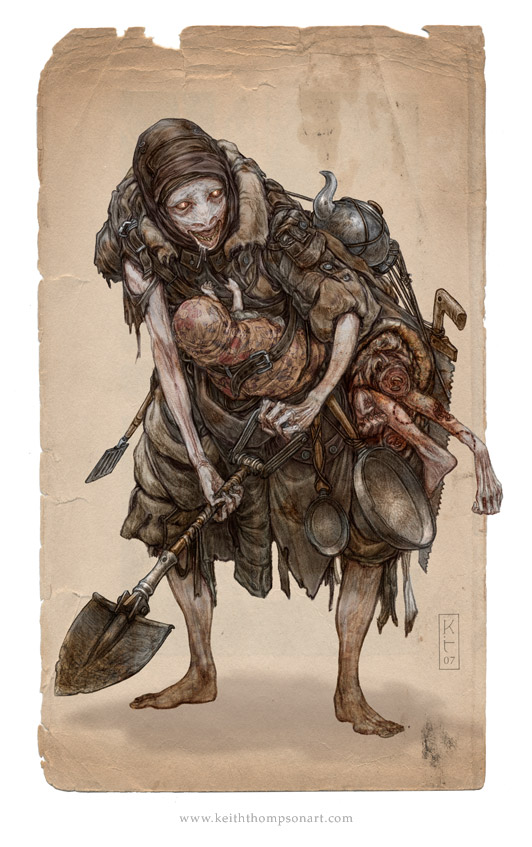
Ghoul

ghoul is a (folkloric) monster associated with graveyards and consuming human flesh, often classified as undead. The oldest surviving literature that mention ghouls is likely One Thousand and One Nights. The term was first used in English literature in 1786, in William Beckford's Orientalist novelVathek, which describes the ghūl of Arabian folklore.
By extension, the word ghoul is also used in a derogatory sense to refer to a person who delights in the macabre, or whose profession is linked directly to death, such as a gravedigger.


Fairy

fairy (also fayfae; from faeryfaerie, "realm of the fays") is a type of mythical being or legendary creature in European folklore, a form of spirit, often described as metaphysicalsupernatural or preternatural. Fairies resemble various beings of other mythologies, though even folklore that uses the termfairy offers many definitions. Sometimes the term describes any magical creature, including goblins or gnomes: at other times, the term only describes a specific type of more ethereal creature or sprite. Various folkloristic traditions refer to them euphemistically, by names such as wee folkgood folk,people of peacefair folk (Welsh tylwyth teg), etc.
Much of the folklore about fairies revolves around protection from their malice. Although in modern culture they are often depicted as young, sometimes winged, humanoids of small stature, they originally were depicted quite differently: tall, radiant, angelic beings or short, wizened trollsbeing two of the commonly mentioned forms. One common theme found among the Celtic nations describes a race of diminutive people who had been driven into hiding by invading humans. When considered as beings that a person might actually encounter, fairies were noted for their mischief and malice.
Fairies are generally described as human in appearance and having magical powers. Their origins are less clear in the folklore, being variously dead, or some form of demon, or a species completely independent of humans or angels.
The concept of "fairy" in the narrow sense is unique to English folklore, conflating Germanic elves with influences from Celtic and Romance (French) folklores, and later made "diminutive" according to the tastes of Victorian era "fairy tales" for children. The English term "fairy" can be applied to comparable beings in any of these cultures, more generally to similar beliefs in other European folklores ("Slavic fairies"), or in comparative studies even worldwide. Fairies have their historical origin in the conflation of Celtic (Breton, Welsh) traditions in the Middle French medieval romances, e.g. as one of the beings that a knight errant might encounter. Fairie was in origin used adjectivally, meaning "enchanted" (as in fairie knightfairie queene), but was used as a name for "enchanted" creatures from as early as the Late Middle English period. Fairies as the term is now understood were shaped in the literature of Romanticism during the Victorian era. Writers such as Sir Walter Scott and James Hogg were inspired by folklore which featured fairies, such as the Border ballads.
Folklorists have suggested that their origin may lie partially in a conquered race living in hiding, or in religious beliefs that lost currency with the advent of Christianity.


Thursday, 8 August 2013

Elf

An elf (plural: elves) is a type of supernatural being in Germanic mythology and folklore. Early elves, whose description depends almost entirely on Norse mythology texts, were a race of beings with magical skills, ambivalent towards humans and capable of either helping or hindering them. But Christianized societies were viewing elves in increasingly sinister light. In Anglo-Saxon England as early as the 10th century, Old English medical books attest to elves afflicting humans and livestock by "elf-shots". The German elf or alp was seen as an "addler" of people in medical books, but already in the High Middle Ages there were prayers warding against it as the agent causing nightmares, and eventually for the alp its identity as nightmare spirits became predominant.
In English literature of the Elizabethan era, "elves" became conflated with the "fairies" of Romance culture, so that the two terms began to be used interchangeably. Romanticist writers were influenced by this (particularly Shakespearean) notion of the "elf," and reimported the word Elf in that context into the German language.
A number of ballads in the British Isles and Scandinavia, perhaps stemming from the medieval period, describe human encounters with the elf, elven-king, elf-maid, etc. The same ballad type (cognate ballads) are often disseminated over several countries. Some common motifs, which may also be seen in British and Scandinavian folklore, are elves enticing men with their dance, and causing death, either by elf-shot or entirely unexplained. In Scandinavia, the elf are often conflated with the beings called the huldra or huldufólk.


Balaur

balaur is a creature in Romanian folklore, similar to a European dragon. A balaur is quite large, has fins, feet, and is polycephalous (it usually has three, sometimes seven, or even twelve serpent heads). As a traditional character which is found in most Romanian fairy tales, it represents Evil and must be defeated by Fat-Frumos in order to release the princess (see also Zmey). It is also believed, in Wallachia that the saliva of a bălaur can form precious stones.
The term Balaur (Macedo-Romanian bul'ar) is of unknown etymology. It has been linked with Albanian boljë ("snake") buljar ("water snake"), all terms possibly stemming from the same Thracian root, *bell- or *ber- "beast, monster", the traces of which can also be found in the name of the Greek mythological heroBellerophon ("the beast killer"). The Transylvanian Saxon balaur "dragon", and balaura, an insult term in Serbia, are borrowed from Romanian. The Serbo-Croatian blavor/blaor/blavur ("European legless lizard") is cognate with balaur, and it is regarded as one of few pre-Slavic Balkan relict words in Serbo-Croatian.


Boggart

Boggart is one of numerous related terms used in English folklore for either a household spirit or a malevolent genius loci inhabiting fields, marshes or other topographical features. Other names of this group include bugbugbearbogeybogeymanbogle, etc., presumably all derived from (or related to) Old English puca and Welsh bwg with the same meaning (itself a probable loan from the English bug).
The household form causes mischief and things to disappear, milk to sour, and dogs to go lame. The boggarts inhabiting marshes or holes in the ground are often attributed more serious evil doing, such as the abduction of children.

Banshee

The banshee (/ˈbænʃ/ ban-shee), from Irishbean sí [bʲæn ˈʃiː] ("woman of the sídhe" or "woman of the fairy mounds") is a female spirit in Irish mythology, usually seen as an omen of death and a messenger from the Otherworld.
In legend, a banshee is a fairy woman who begins to wail if someone is about to die. In Scottish Gaelic mythology, she is known as the bean sìth or bean-nighe and is seen washing the bloodstained clothes or armour of those who are about to die. Alleged sightings of banshees have been reported as recently as 1948. Similar beings are also found in WelshNorse and American folklore.